The American Pilot's Roadmap: What It Really Takes to Go From Student to Airline First Officer
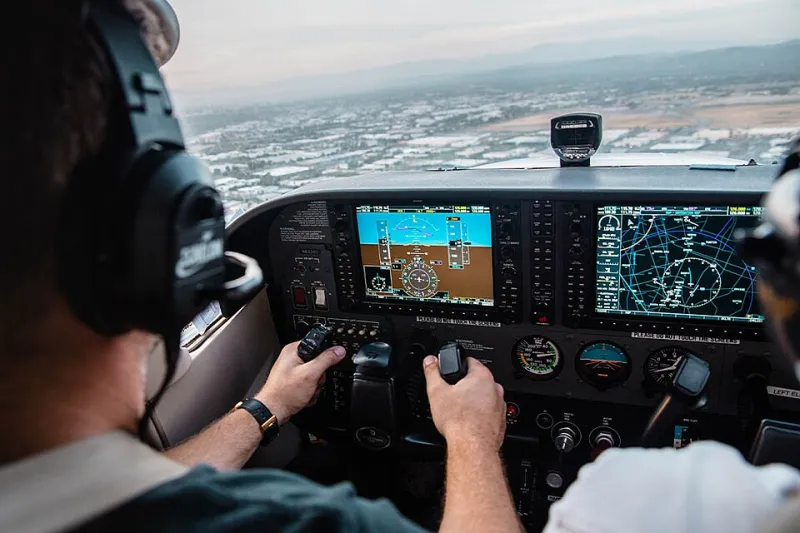
Photo: Johnpilot, CC BY-SA 4.0, via Wikimedia Commons
Every year, thousands of Americans decide they want to fly for a living. Some are high school seniors weighing aviation colleges; others are professionals in their thirties trading a desk for a flight deck. What separates those who earn their wings from those who only dream about them is rarely talent. It is a clear understanding of the road ahead — and the willingness to travel it one hour at a time.
At Helang Flying Academy, we walk this road alongside our students every day. Here is what the journey actually looks like.
The Foundation: Private Pilot Certificate (Months 1–6)
Everything begins with the FAA Private Pilot certificate, which requires a minimum of 40 flight hours — though most students log closer to 55–70 before reaching checkride readiness. Expect to invest roughly $12,000–$18,000, depending on aircraft type, rental rates, and how consistently you fly.
Consistency matters more than intensity. Students who fly two or three times per week typically finish faster and spend less, because muscle memory builds between lessons rather than evaporating between them.
"I came in thinking I'd knock it out in three months," says one Helang student. "My instructor reminded me that weather, scheduling, and the FAA written exam all take time. Planning for nine months instead of three kept me from getting discouraged."
Building Blocks: Instrument and Commercial Ratings (Months 6–18)
The next stage transforms a fair-weather flyer into a professional candidate. The Instrument rating teaches precision flying in clouds and low visibility, while the Commercial certificate — requiring 250 total flight hours under FAR Part 61 — is where piloting becomes a profession.
Many students accelerate this phase by enrolling in a structured Part 141 program or by completing a Certified Flight Instructor (CFI) pathway. Earning instructor certificates is the classic American solution to the hour-building problem: you get paid to fly while accumulating the experience airlines require.
Typical costs across this stage range from $30,000 to $50,000, bringing total training investment to roughly $60,000–$90,000. Financing, GI Bill benefits at eligible institutions, and airline cadet partnerships have made this figure far more manageable than it once was.
The Turning Point: Flight Instruction and Hour Building (Years 1–3)
Here is where timelines diverge sharply. A CFI working full-time can log 60–100 hours per month, reaching the 1,500-hour Airline Transport Pilot (ATP) requirement in 18–24 months. Those who can only fly part-time should plan for three to four years.
There is no shortcut around this milestone. The ATP rule, strengthened after 2009, exists for good reason — and airlines value the depth of judgment that only accumulated hours provide.
The Destination: Regional Airlines and Beyond (Years 2–5)
Once you hold the ATP certificate with restricted privileges (1,000–1,250 hours for qualified university graduates) or the full 1,500, regional carriers hire aggressively. A new-hire regional first officer can expect roughly six months of airline training, followed by type rating in an Embraer E175 or CRJ.
From there, the trajectory is well-established: upgrade to captain in two to four years, then flow through or move to a major carrier. Many pilots flying wide-body routes today began their journey at a small academy strip less than a decade ago.
A Realistic Composite Timeline
- Months 1–9: Private Pilot certificate
- Months 9–18: Instrument and Commercial ratings, CFI certificates
- Years 1–3: Flight instructing and hour building to 1,500 hours
- Years 3–4: Regional airline new hire and initial training
- Years 5–7: Regional captain, then major airline consideration
The Honest Bottom Line
The full journey typically spans four to six years and $70,000–$100,000. That sounds daunting until you weigh it against airline first-year pay — now frequently exceeding $90,000 at regionals — and the long-term earning power of an aviation career.
The pilots who succeed are not the ones with perfect circumstances. They are the ones with a plan, a realistic budget, and a training environment that keeps them accountable. That is precisely what we have built at Helang Flying Academy.
If you are ready to stop calculating and start flying, schedule a discovery flight with us. The roadmap is long, but every hour counts — and yours are waiting to be logged.