The Unspoken Handshake: What You Owe Your CFI, and What You Should Never Owe Them
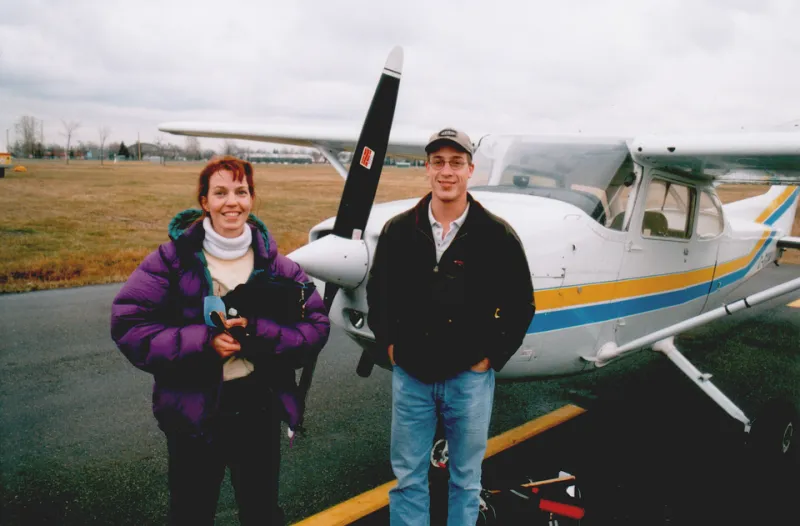
Photo: Ahunt, Public domain, via Wikimedia Commons
Before your first lesson at any flight school in America, you'll sign paperwork: a training agreement, a syllabus, maybe a payment plan. But the most consequential contract of your flight training will never appear on paper. It's the unwritten handshake between you and your Certificated Flight Instructor — a relationship part coach, part evaluator, part confidant, and occasionally, if you're not careful, something that resembles therapy.
Getting that relationship right can be the difference between a checkride passed in minimum hours and a training story that ends in a drawer of unused logbook pages.
The Job Description Nobody Reads
A CFI's official job is narrow: teach you to fly safely and to the practical test standards. Everything else — the pep talks, the career advice, the post-flight diner debriefs about your divorce or your career anxiety — is extra. And yet it happens constantly, because flight training is intimate in a way few educational experiences are. You sit eighteen inches from someone for hundreds of hours while performing high-stakes tasks under evaluation.
Instructors we spoke with across the country describe the same tension. "You become the person who sees someone on their worst day," one Arizona-based CFI told us. "They show up tired, scared, broke, or all three. Part of the job is reading that. But part of the job is knowing you're not equipped to fix it."
That distinction matters. A good instructor notices when a student's landings fall apart because of something happening at home. A great one adjusts the lesson accordingly — and then points the student toward actual support when the problem is bigger than aviation. What a good instructor never does is pretend that encouragement can substitute for proficiency.
When Mentorship Curdles Into Dependency
There's a healthy version of the student-instructor bond. Mentors open doors: they make the introduction to the regional airline recruiter, they let you tag along on a ferry flight, they tell you the truth about your readiness when a syllabus checkbox won't. Many working airline pilots can name the CFI who changed their trajectory.
But dependency is the shadow side of that same dynamic. Warning signs that the relationship has drifted:
- You can't self-brief anymore. If you still need your instructor to interpret a TAF or plan a cross-country after the solo phase, something's wrong — either with the instruction or your initiative.
- Progress has stalled but nobody names it. You've flown the same lesson three times, and neither of you has said the word "plateau."
- The relationship feels transactional in one direction. Your instructor bills time; you buy reassurance. Comfort is not a training outcome.
- You're protecting their feelings. If you're afraid to ask a question because it might seem like a challenge, you've stopped being a student and started being an audience.
The Instructor's Side of the Ledger
Students aren't the only ones who struggle with the relationship. Ask any CFI about the student they couldn't reach and you'll get a long pause. Usually it's not about aptitude. It's about the student who arrived without preparing, who treated each lesson like an amusement park ride rather than a rehearsal for a checkride, or who argued with every correction.
"The hardest students weren't the slow ones," a Florida instructor with 3,000 dual hours told us. "They were the ones who wanted a pilot certificate more than they wanted to be a pilot. I can teach anyone to land. I can't teach someone to care about a checklist."
Instructors have obligations under the unwritten handshake too: show up prepared, be honest about readiness even when the student is paying by the hour, and recognize when your own ceiling has been reached. A CFI who has never flown in actual instrument conditions has no business teaching an instrument student to shoot an approach to minimums — and the ethical ones will say so.
Knowing When to Request a Change
Here is the sentence students find hardest to say: "I'd like to fly with a different instructor."
It feels like a betrayal. It isn't. Instructors change students all the time for scheduling, aircraft, and stage-check reasons, and a professional CFI will not take it personally. In fact, many respect a student who advocates for their own training — it's exactly the self-advocacy you'll need as a professional pilot dealing with dispatchers, schedulers, and captains.
Request a change when:
- You've plateaued despite honest effort, and the same explanations keep repeating.
- Your learning style and their teaching style simply don't mesh after a genuine attempt.
- The relationship has become social rather than instructional.
- Your gut tells you the standard being applied isn't the practical test standard.
Do it directly and without grievance. "I've learned a lot flying with you, but I think I need a fresh perspective for this stage" is a complete sentence. Then take the debrief: ask your former instructor what they'd have done differently with you. That conversation is often worth more than ten hours of dual.
The Contract, Restated
So what does each side actually owe the other? The student owes preparation, honesty about weaknesses, and payment on time. The instructor owes candor, preparedness, and the professional discipline to keep the relationship instructional. Neither owes the other friendship, though friendship frequently happens and is a gift when it does.
What neither party should ever do is confuse the cockpit with a confessional. The flight deck rewards clear roles. You will one day sit in a cockpit with a captain you've known for forty minutes, and the professional distance you practice now — respectful, honest, bounded — is a skill you're building whether you know it or not.
Your wings are waiting. The person in the right seat can help you earn them, but they cannot earn them for you — and the sooner you both agree on that, the sooner you'll fly.