Who Just Keyed the Mic? Decoding the Cast of Characters on a CTAF
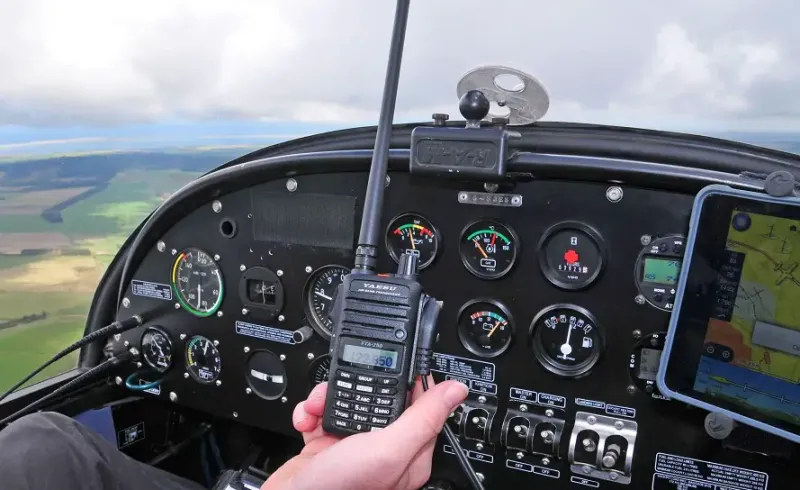
Photo: small rural airfield pilot radio cockpit single engine plane, via www.radiopicker.com
The first ten hours of solo flight at a controlled field teach you to speak one dialect of aviation. The moment you start operating at uncontrolled airports — and you will, early and often — you discover that the CTAF is less a radio channel and more a small town's party line, populated by characters your ground school never warned you about.
At Helang Flying Academy, we tell every student the same thing: mastering the microphone at a tower field is a skill. Learning to listen at a nontowered field is a different skill entirely, and arguably the more important one. Roughly three-quarters of the airports you'll visit in your career have no tower at all. The frequency is your only picture of traffic, and that picture is painted by a colorful, inconsistent, occasionally baffling cast.
The Ag Pilot Who Owns the Frequency
Somewhere over the bean fields, a spray plane is working at 120 knots, 50 feet off the deck, and its pilot has better things to do than full position calls. You'll hear fragments — "ag traffic west of the field," maybe a terse call sign, maybe nothing for twenty minutes while the aircraft works in a loop over the same section of farmland.
The mistake new pilots make is treating this silence as an all-clear. The right move is the opposite: assume the ag operator is exactly where you can't see him, usually low, usually fast, and usually turning. Give the area a wide berth, announce your position generously, and remember that the aerial applicator probably knows this airspace better than anyone alive. He's just not going to narrate it for you.
The Balloon That Never Answers
Hot air balloons occupy a strange corner of the CTAF universe. Many operate without transponders, some without radios, and the ones that do have radios often treat them as optional equipment. You may hear a laconic "balloon aloft, northeast of the field, drifting" at 6 a.m. and then nothing further for an hour.
Balloons cannot maneuver to avoid you the way an airplane can — they go where the wind goes. If you're flying an early-morning pattern at a rural strip during festival season, build the possibility of a silent, slow-moving envelope of nylon into your scan. They're most common at altitudes and times when you'd otherwise have the sky to yourself.
The One-Call Wonder
Every nontowered field has a pilot who believes a single "anyone in the pattern?" at midfield constitutes a complete communications protocol. No position reports, no traffic advisories, just a question posed to the universe and then radio silence until an abrupt "full stop, taxiing clear."
The Aeronautical Information Manual recommends specific calls for each phase of flight at a nontowered airport precisely because the system only works when everyone participates. You can't fix the One-Call Wonder, but you can refuse to become one. Over-communicating at an uncontrolled field is almost never a fault. Under-communicating certainly is.
The Skydive Operator's Litany
Jump pilots, by contrast, may be the most disciplined communicators on the frequency — for good reason. When a Cessna 182 drops a load of jumpers from 10,000 feet, the resulting stream of humanity falls through your airspace for the better part of a minute. Listen for the standard calls: jumpers away, jumpers over the field, jumpers down. Until you hear "clear of the area," treat a several-mile cylinder over the drop zone as occupied. This is one voice on the CTAF you should never tune out, because the people falling out of that airplane have no engine, no radio, and no way to see you.
The Fly-In Crowd and the Chatty N-Number
Then there's the opposite problem: the weekend fly-in, the airshow practice session, the banner tow pilot who provides a running commentary of his entire route. The frequency turns into a wall of overlapping transmissions, and your job shifts from broadcasting to extracting signal from noise. Shorten your calls. Keep your head outside. When the frequency is congested, a crisp "N123AB, downwind, runway two-four, full stop" earns you more space than a paragraph ever will.
Why This Dialect Matters for Your Career
It's tempting to file nontowered radio work under "student pilot chores" — something you endure until you're talking to center on an airline route. That's backwards. Airlines, corporate flight departments, and charter operators all evaluate how a pilot handles ambiguity, and the uncontrolled field is where ambiguity lives. A candidate who describes reading the traffic picture at a busy CTAF — who talks about building a mental model from partial calls and silence — sounds like a professional in the making.
So the next time you key the mic at a quiet county strip and a spray plane grunts something unintelligible in return, don't be discouraged. You're not failing at radio work. You're learning the oldest dialect in general aviation, one character at a time. The tower will teach you precision. The CTAF teaches you judgment — and judgment is what the right seat is actually made of.