Before You Key the Mic: Lessons From the Other Side of the Radar Scope
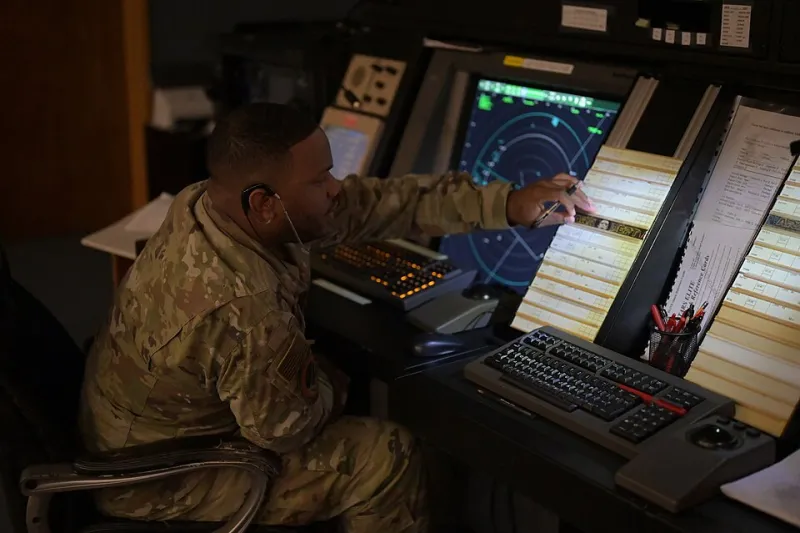
Photo: Senior Airman John Wright, Public domain, via Wikimedia Commons
Every busy frequency is a shared room with no walls. On a Saturday morning at a Class D airport, that room can hold a flight school Cessna, a medevac helicopter, a business jet on final, and a student pilot on his third solo. The controller is not just separating traffic; he is managing a conversation. The pilots who make that conversation easy are rarely the ones with the smoothest voices. They are the ones who listened before they keyed the mic.
The Frequency Is a Shared Room
Controllers consistently describe the same frustration: a pilot who transmits before knowing what he wants to say. The result is dead air, a half-formed request, and a controller waiting while three other aircraft circle. Before you press the button, know four things: who you are calling, who you are, where you are, and what you need. Write the callsign down. Have the airport diagram open. Copy the ATIS before you start the engine, not while you are rolling toward the run-up area.
This is not about sounding polished. It is about respecting the room. A short pause to organize your thoughts costs two seconds. A rambling transmission costs everyone else on the frequency.
Readbacks That Help, Not Hurt
A readback is not a performance. It is a safety check. Controllers listen for the specific items that matter: runway assignments, hold short instructions, altitude assignments, turn headings, and frequency changes. If you read back the entire taxi route but miss the hold short instruction, you have wasted the transmission and created risk.
When a clearance is long, read back the critical parts and ask for clarification on the rest. 'Say again the taxi route after Bravo' is a professional call. Guessing is not. Controllers would rather repeat a clearance than wonder whether you understood it.
One habit that quietly helps: put your callsign at the end of the readback, not in the middle of every phrase. It gives the controller a clear finish line. Another: do not add commentary. 'Roger, thanks, we are a student pilot, we will be slow' may feel courteous, but it clogs the frequency. Save the context for when it changes the controller's plan.
The Small Mistakes That Clog a Busy Frequency
Controllers mention several recurring patterns. The first is the phantom transmission: a pilot keys the mic, pauses, and then speaks. On a congested frequency, that pause blocks everyone. The second is the long story. A request for flight following does not need your life history; it needs your position, altitude, and destination. The third is using the wrong frequency for the wrong purpose. CTAF is for traffic coordination, not for extended conversations about the weather.
There is also the matter of correcting yourself. Everyone misreads a clearance. The professional response is quick: 'Correction, N12345, hold short of runway 22.' Apologize once if you must, then move on. Controllers are not grading your dignity. They are separating airplanes.
Preparation Before Push-to-Talk
Student pilots often treat radio work as a separate skill from flying. It is not. The same situational awareness that keeps you ahead of the airplane keeps you ahead of the transmission. Chair-fly the radio calls before your lesson. Practice the readback for the clearance you are most likely to receive. Review the airport diagram until you can point to your position without thinking.
At Helang Flying Academy, we teach radio work as part of preflight preparation, not as an afterthought. The goal is not to memorize scripts. The goal is to build a habit: listen, think, then transmit.
When You Get It Wrong
You will get it wrong. You will call the wrong facility, read back the wrong runway, or forget your callsign. The fix is simple and unglamorous. Stop. Correct it. Keep it short. The frequency does not need your embarrassment; it needs your clarity.
Controllers do not expect perfection from student pilots. They expect the same thing good instructors expect: preparation, honesty, and a willingness to listen. The other side of the frequency is not a mysterious authority. It is a person managing a room. Help them do it, and you will find that the room helps you back.