Keying the Mic Before You're Ready: Why Your Worst Radio Call Is Your Best Teacher
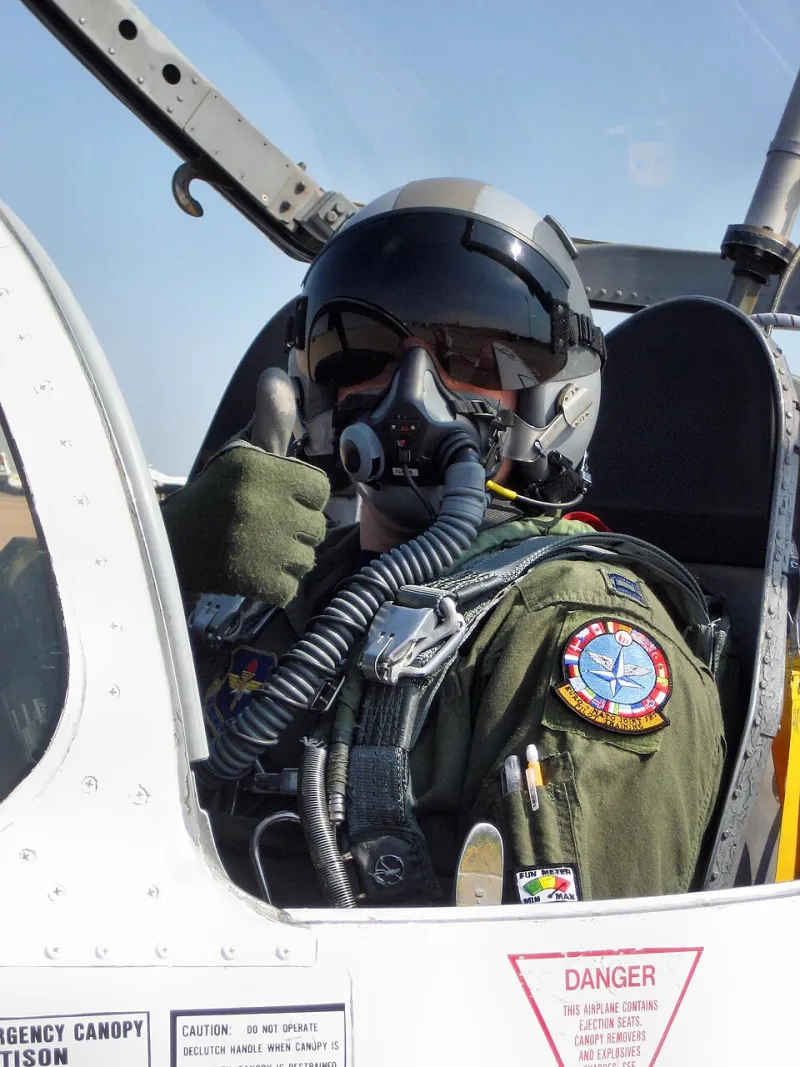
Photo: derivative work: JoJanJoJan (talk) T-37_solo_student_pilot.JPG: Dual Freq INFORMATION, CC BY 3.0, via Wikimedia Commons
There's a moment familiar to every pilot who has earned their wings at a busy American flight school: you're handed the radio at midfield, tower clears you to land, and what comes out of your mouth is — technically — English. Barely. The readback collapses into a mumble, half the instructions vanish, and tower patiently asks you to "say again." Your face burns behind the headset. The airplane, mercifully, doesn't care.
At Helang Flying Academy, we tell every new student the same thing on day one: the radio will embarrass you before it serves you. That's not a warning. It's a promise worth keeping.
The Myth of the Polished First Call
Somewhere along the way, student pilots absorbed the idea that confident radio work is a prerequisite for training rather than a product of it. Blame the cockpit videos, the airline radio chatter on YouTube, the polished phraseology of a Delta captain working Chicago Center. Those voices represent twenty years of repetition, not some natural gift.
The truth is less glamorous and far more encouraging: nobody sounds good on the radio at first. Nobody. The controller who hears your halting readback has heard a thousand worse this week, and most of them came from pilots who now sound effortless.
What Actually Goes Wrong — and Why It's Fine
The failures follow a predictable pattern, which should tell you something. They are not unique disasters; they are a curriculum.
The jammed transmission. You key the mic while someone else is talking, and two voices collide into electronic mush. Everyone on frequency winces for a half second, then moves on. The fix — listen, then speak — only becomes instinct after you've stepped on a few calls.
The vanished readback. Tower issues a taxi instruction with a hold-short at a specific taxiway, and you parrot back "roger" — which, in FAA-speak, means nothing at all. Controllers will chase you down for the full readback, and you'll never forget to give one again. That lesson costs you ten seconds of mild embarrassment. It's the cheapest instruction you'll ever receive.
The blank stare at a busy frequency. Approach control rattles off a heading, an altitude, and a squawk code, and your mind simply declines to store any of it. The solution every experienced pilot eventually adopts — write it down, every time — gets adopted precisely because the memory fails once in a memorable way.
The wrong words entirely. "Um, we're, like, gonna be ready soon?" instead of "Cessna 7-3-2-Whiskey, ready for departure, runway two-seven left." ATC will translate. The phraseology will come. It always does.
What ATC Actually Thinks
Here is the reassurance nobody gives student pilots plainly enough: air traffic controllers are not grading you. They are working traffic. Their job is to keep airplanes separated, and a clumsy but honest transmission is infinitely easier to handle than a silent or overconfident one.
If anything, controllers respect students who identify themselves as students. Saying "student pilot" on your first visit to a Class D tower invites patience you didn't know was available. Controllers at fields like those around our training area would rather give you a slower, clearer instruction than guess what you meant.
The pilots who create real problems on frequency are not the ones who fumble. They're the ones who fake their way through a readback they didn't understand.
A Framework for Getting Better Before You're Good
You cannot shortcut the reps, but you can make each rep count more.
Rehearse the call before you make it. Before contacting ground, say the full transmission out loud in the cockpit, twice. Who you are, where you are, what you want. The words are finite and predictable; rehearsing them removes half the pressure.
Keep a kneeboard script. For your first ten towered operations, write out the expected calls and the likely responses. Fill in the blanks as they come. This is not a crutch — it's how airline crews use flows and checklists.
Listen to live ATC at home. LiveATC archives let you hear real frequencies at your local field. Ten minutes a night trains your ear to the rhythm and pacing before your voice ever has to join it.
Adopt the three-second rule. Before keying the mic, three seconds of listening. Before answering, three seconds of composing. Speed on the radio is a byproduct of accuracy, never the goal.
Debrief your own calls. After landing, replay the worst transmission of the flight in your head. Not to punish yourself — to name the failure. Was it timing? Vocabulary? Memory? Each failure has a specific fix.
Permission to Sound Like a Student
There is a strange freedom in accepting that your radio work will be imperfect for a while. The fear of sounding amateur keeps some prospective pilots from ever starting training at all — a quiet tragedy, because the fear is built on a standard nobody meets.
The captain whose voice sounds like warm honey on the ATIS-adjacent frequencies earned that voice one awkward readback at a time. So will you. The microphone is not a test you pass before you fly; it's a skill you build while flying, one slightly clumsy call at a time.
So key the mic. Say it wrong. Get corrected. Say it better tomorrow. Your wings are waiting — and so, patiently, is the controller on the other end.