Press to Talk, Not to Panic: Getting Comfortable With the Microphone Before Your Solo Cross-Country
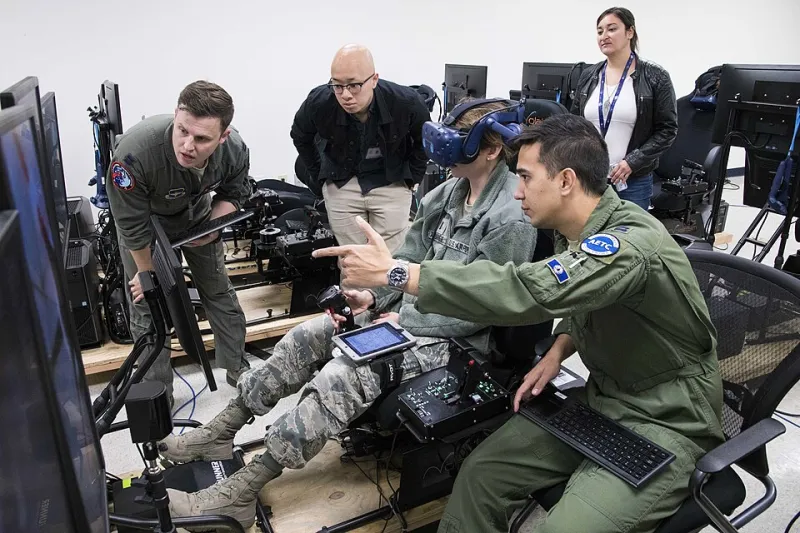
Photo: Sean M. Worrell, Public domain, via Wikimedia Commons
Ask any pilot at any FBO in America about their first transmission on the frequency, and you will usually get a laugh followed by a confession. The hands sweat. The words tangle. Somewhere between reading back a clearance and actually flying the airplane, something has to give. At Helang Flying Academy, we tell every new student the same thing: the microphone is a skill, not a talent, and like every skill in aviation, it can be practiced on the ground before it is ever needed in the air.
The Fear Is Real, and It Has a Name
Student pilots call it 'radio fright,' and it is one of the most common anxieties in flight training. The fear is rarely about the words themselves. A pilot who can explain a crosswind landing in fluent detail suddenly freezes when asked to say 'N-number' and 'inbound for landing' in the same breath.
The panic usually comes from three sources: the speed of the traffic, the fear of sounding inexperienced, and the knowledge that everyone else on frequency seems to know exactly what they are doing. The truth, which experienced pilots learn eventually, is that half the people on a busy CTAF or approach frequency are improvising too.
Consider the stories that circulate around every flight school in the country. One student, cleared to taxi at a Class D field in Texas, read back the entire clearance twice, then sat frozen on the taxiway because she could not remember the phrase for 'ready to taxi.' Another, on his first contact with approach control in Florida, keyed the mic, said 'uh,' and then a full ten seconds of silence before finishing the call. The controller waited patiently and never mentioned it. These are not failures. They are the standard tuition every pilot pays.
What the Controller Actually Expects
Here is the reassurance most students never hear plainly enough: air traffic controllers are not grading your phraseology. They are listening for four things: who you are, where you are, what you want, and whether you understood them. Everything else is polish.
Controllers at even the busiest tower cabs will tell you the same thing. They would rather hear a slow, slightly clumsy, correct readback than a fast, confident, wrong one. Readback errors are a genuine safety issue. A nervous 'say again, please' is never an inconvenience. It is the system working exactly as designed.
A few points worth internalizing before your first radio call:
- Slow down. Nervous pilots talk fast. Controllers talk fast because they do it hundreds of times a shift. You are allowed to speak at your own pace.
- Think before you key. Formulate the call in your head first. A two-second pause before transmitting is invisible to everyone else.
- Write it down. Copying clearances word for word in the squawk book or on a kneeboard is not a beginner crutch. Airline crews do it.
- Use the full callsign. Shortened callsigns are earned after the controller uses yours first, not before.
Practice Drills That Actually Work
The microphone responds to rehearsal the same way landing does. You would not attempt your first solo without pattern work, and you should not attempt your first solo cross-country without radio rehearsal.
Chair flying the frequency. Sit at home with a sectional, a kneeboard, and a script of your planned route. Call every position out loud: departure request, altitude change, traffic advisories, landing clearance. Say the words with your mouth, not just your mind. The muscle memory matters.
LiveATC immersion. Recordings of real tower and approach frequencies, available free online, are the single best ear-training tool available to a student pilot. Pick a Class D airport near you and listen for twenty minutes a day. Within two weeks you will start predicting the calls before the pilots make them.
The readback drill. Have a flight instructor or study partner read clearances at random. Read them back verbatim. Start slow, then increase the pace. When you can copy a full IFR clearance at conversational speed, the real thing will feel manageable.
Simulate the worst case. Practice the recovery phrases out loud until they are automatic: 'Say again,' 'Say again all after your callsign,' and 'Standby.' Knowing you have a graceful way out of any transmission removes most of the fear before it starts.
The Moment It Clicks
Somewhere over the practice area, usually a few weeks after the cross-country endorsement, something shifts. The radio stops being an adversary and becomes what it always was: a tool, and a remarkably forgiving one. The student who once rehearsed a taxi call three times in her head now rattles off flight service requests while trimming the aircraft.
No one becomes articulate on the frequency overnight. The goal is not eloquence. It is competence, calm, and the quiet confidence of knowing that a mistake on the radio is correctable, survivable, and utterly ordinary.
Your wings are waiting, and so is your voice on the frequency. Earn both one transmission at a time.