Counting Every Dollar Between the Ramp and the Right Seat
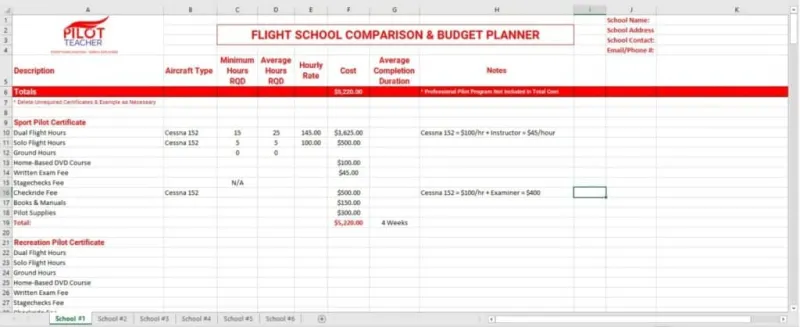
Photo: pilot student calculating flight training costs with budget documents and calculator, via pilotteacher.com
Every pilot remembers the first hour. Few remember to budget the last one.
Flight training has a way of revealing its true cost slowly — a fuel surcharge here, a checkride retest there, an unexpected medical deferral that requires a specialist visit. At Helang Flying Academy, we believe the dream deserves better than vague estimates. So here is the unvarnished arithmetic, from your first discovery flight to the day you are qualified for an airline interview.
Where the Money Actually Goes
The entry ramp. A discovery flight typically runs $150 to $300. Consider it tuition for the most important decision you will make: whether this life is for you.
Private pilot certificate. Nationwide, expect $12,000 to $20,000. The FAA minimum is 40 flight hours, but the national average hovers near 65 to 70, and the hourly rate for a training aircraft with instructor runs $180 to $260 depending on region and aircraft type. Ground school, the FAA written exam (around $175), and the checkride (roughly $600 to $900 with examiner fees) all add up.
Instrument rating. Budget $10,000 to $15,000. This is where simulator time, approach plates, and precision flying raise the per-hour cost.
Commercial certificate and beyond. The commercial certificate adds $8,000 to $12,000. Add multi-engine training ($4,000 to $8,000), and the certified flight instructor certificate ($5,000 to $8,000) if — like most aspiring airline pilots — you plan to build hours by teaching.
The quiet line items. Aviation medical certificate: $100 to $200 per exam. Headset: $300 to $1,100. Knowledge test prep materials, charts, a subscription to a flight-planning app, renters insurance. A reasonable miscellaneous budget is $1,500 to $3,000.
The full journey from zero hours to CFI commonly lands between $65,000 and $85,000 at an accelerated academy, or somewhat less at a part-61 school with a patient pace.
Paying for It: More Options Than Most People Realize
Federal benefits. Veterans with GI Bill eligibility can have a substantial portion of flight training covered at approved Part 141 schools — one of the most underused funding sources in aviation.
Scholarships. Organizations like AOPA, Women in Aviation International, the Experimental Aircraft Association, and the Organization of Black Aerospace Professionals award millions annually. Many go unclaimed because candidates assume they won't qualify. Apply anyway.
Airline cadet programs. Major and regional carriers partner with academies to offer financing support, mentorship, and in some cases conditional employment pathways. These programs trade some flexibility for security — a fair trade for many students.
Loans and payment plans. Aviation-specific lenders exist, and many schools offer stage-payment structures. Borrow conservatively: a CFI salary, while modest, services debt far more comfortably than anticipated airline income you don't yet have.
Budget Like a Pilot, Not a Dreamer
The students who finish are rarely the ones with the most money. They are the ones who planned for the whole flight, not just the takeoff. Build in a 15 percent buffer. Fly at least twice a week — currency saves money. And treat every dollar spent as a down payment on a career measured in decades, not years.
Your wings are waiting. Earn them here — with a budget that holds up all the way to cruise altitude.